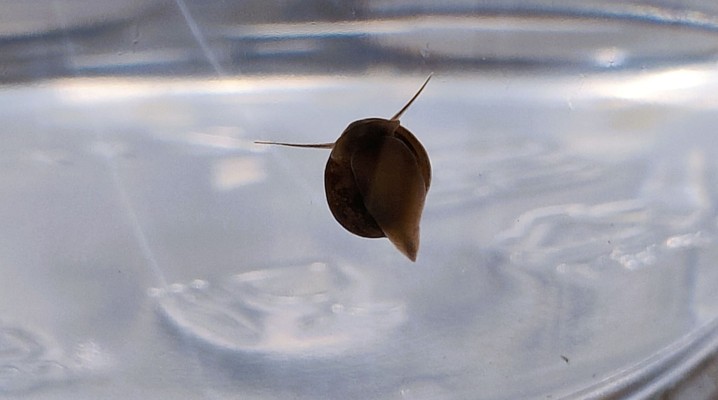
This blog post is provided by Janice L. Yan and Richard Szeligowski and tells the #StoryBehindThePaper for the article “Fear generalization, cross-sensitization and behavioural responses to multiple dangers in a freshwater snail”, which was recently published in Journal of Animal Ecology. In their study, Yan, Szeligowski and colleagues test generalised fear responses in a species of freshwater snail, exploring how sensitivity to disparate threats may shape survival in the wild.
The world can be a dangerous place for animals. Studying behaviour allows us to understand how animals rapidly respond to different dangers. Like humans, animals have personalities where individuals differ consistently in their behavioural tendencies. For example, within the same population of animals, some individuals will be more willing to take risks whereas others consistently choose safety. Ecologists often use the term “Landscape of Fear” to describe how the risk of danger influences animal behaviour and measure fearfulness based on how intensely animals avoid risk. However, most research on fear in animals has focused on the threat of getting eaten by predators. Yet predators are not the only danger animals have to worry about!
Given that wildfires have been on the rise worldwide and pose a significant risk for all kinds of animals, we decided to investigate whether animals differ in how fearful they are of ash, a chemical stressor associated with wildfire. We also tested fear responses to predators as we wanted to understand whether animals’ fearfulness of different dangers tended to be correlated. In other words, if an individual flees much more quickly than others after detecting a predator, will that same individual also avoid a wildfire-associated chemical stressor more intensely? This concept of correlated fears across multiple dangers is known as “fear generalization”.
To answer our questions, we used a species of freshwater snail (Physa acuta) caught in a stream near Davis, California. Why snails? Because not only are they relatively easy to rear, but their fear responses are also easy to measure in the lab. By placing a little algae at the bottom of a plastic cup, half filled with water, a hungry snail will naturally make its way to the bottom of the cup to eat. We then introduce a single droplet of water that either contains dissolved ash, our chemical stressor, or cues of crayfish, a natural predator of freshwater snails.
Some snails consistently respond quickly, moving as fast as a snail can to the surface of the water. Particularly frightened snails may even exit the water and keep climbing up the side of their cup to escape the threat! By measuring how quickly individual snails reach the water’s surface, or if (and how quickly) they climb out of the water, we could compare their fear responses to two, very different dangers.
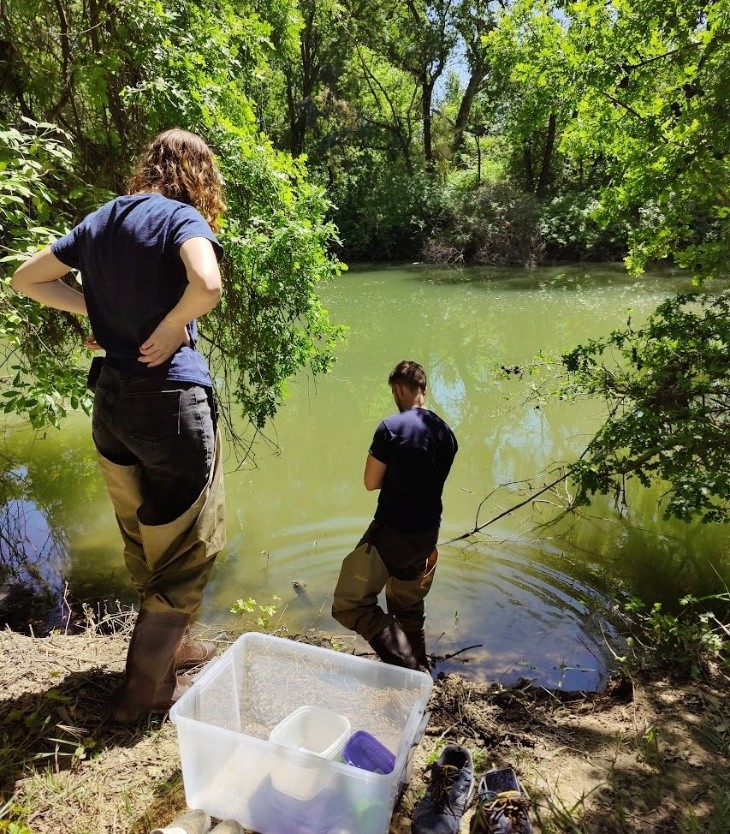
We also wanted to understand how early life experience with each stressor influenced fear responses later in life. Therefore, we manipulated the juvenile rearing conditions of our snails. A third of our snails were raised with constant exposure to predator cues, a third were exposed to ash, and the final third were raised in control water with no cues of danger. This approach let us test how an animal’s developmental environment shapes their future responses to threats.
Even more exciting is that our experiment can help us understand how exposure to one danger during development affects an individual’s fear of new dangers later in life. If an animal raised in the presence of a danger responds more strongly to the same danger later in life, we call that “sensitization” or “priming”. If an animal raised in the presence of one danger responds more strongly to a different, new danger later in life, we call that “cross-sensitization”. Both sensitization and cross-sensitization have important implications for how animals cope with multiple threats, especially in an increasingly unpredictable world.
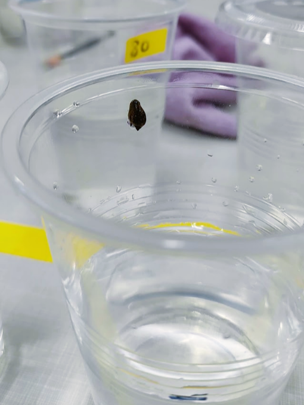
So, when our snails reached adulthood, how did they respond to ash and predator cues? First, by testing each snail multiple times with each threat, we found consistent individual differences in their responses to both dangers. In other words, some snails were consistently more afraid of ash compared to other snails. Likewise, some snails were consistently more afraid of predator cues compared to other snails.
More interestingly, it was generally the same snails that were extra afraid of both stressors as the snails that fled to the surface more quickly in response to predation risk also fled more quickly in response to ash. This means that our snails showed fear generalization across two very different dangers! Finally, our snails showed patterns of both sensitization and cross-sensitization. Snails reared in either stressor were more responsive to both stressors later in life.
Our finding that responses to ash and predation are correlated, and that snails exhibit cross-sensitization across these two disparate threats suggests that a population’s history of predation can help prepare it for other types of danger. In this case, increased avoidance of ash may be beneficial if it leads to less accumulated toxins and heavy metals often found in ash. However, while fleeing to the surface or out of water might help our snails reduce their exposure to toxins or the risk of getting eaten by aquatic predators, they also risk becoming more vulnerable to terrestrial predators and desiccation (drying out). Fleeing also leads to lost foraging opportunities. Therefore, future research should examine the adaptive significance of fear generalization, focusing on the benefits and costs associated with both over- and under-avoiding risks.
Lastly, little is known about the genetic, physiological, and neurobiological mechanisms underlying fear generalization and behavioural cross-sensitization. Studying these mechanisms can help us understand the evolution of fear and risk-taking across species. While fear generalization and behavioral cross-sensitivity are exciting avenues of research, these topics are relatively unexplored and much more research is needed to understand the mechanisms underlying these phenomena, and how they shape survival and fitness in the wild.
Read the paper
Read the full paper here: https://doi.org/10.1111/1365-2656.70393

