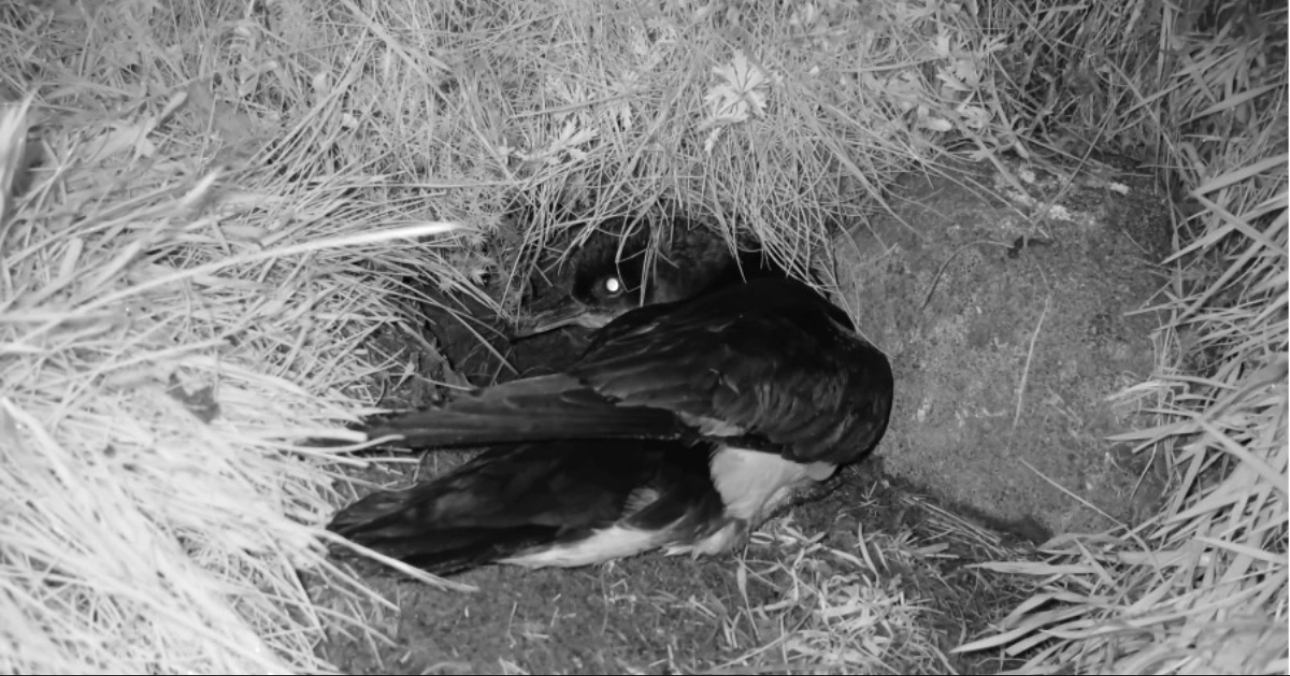
This blog post is provided by Katrina Siddiqi-Davies and tells the #StoryBehindThePaper for the article, “Why don’t all birds lay early? Causes and consequences of breeding timing for a long-lived migratory seabird“. This study investigated why some birds consistently return to their breeding colonies and lay their eggs earlier than others, finding that individual differences in migration timing, breeding partners and seasonal food availability all play a role. The findings highlight how changing environmental conditions may influence breeding success and challenge the assumption that earlier breeding always leads to better outcomes.
As someone who is chronically late, I often wonder how animals manage to show up on time. I have access to clocks to remind me the time, calendars to help me plan and Google Maps to predict how long it will take to get somewhere. As far as I’m aware, migratory birds don’t have any of this technology, and yet still manage to fly around half the world and show up on time for breeding each year. I’ve been studying a seabird called the Manx Shearwater for the last six years on Skomer Island (Ynys Sgomer) off the coast of West Wales and am ever impressed by some of these birds’ punctuality.

After they’ve finished breeding, Manx Shearwaters migrate across hemispheres, flying 12,000 km from Wales to the Patagonian shelf (near South America). They spend the winter there, gorging on fish before returning dutifully to become a parent once more in the spring. My research group, Oxnav (the Oxford Navigation Group) has been tracking this migration since 2007, deploying tiny loggers that weigh less than a gram on a colourful ring attached to the birds’ leg, allowing us to track their behaviour across multiple years.
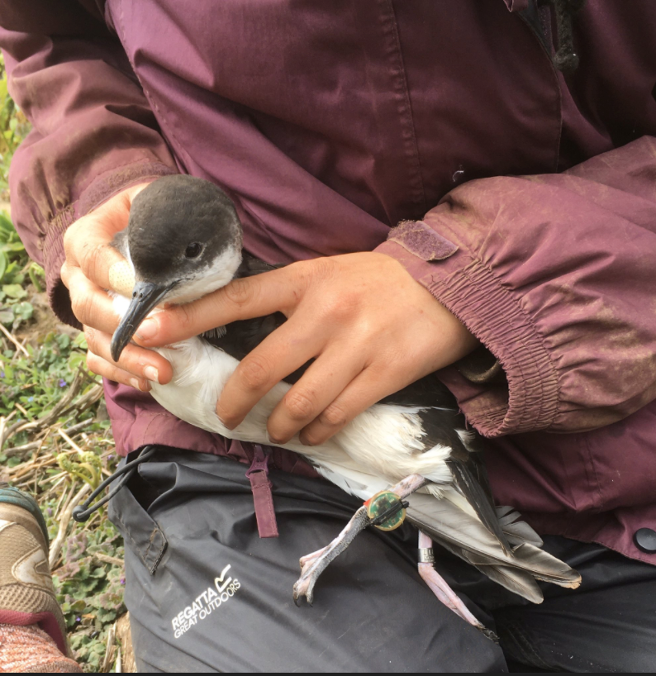
Exploring this data, I noticed that many birds arrived back at the breeding colony on almost the exact same day as the year before. This completely blew my mind! However, birds were all on their own schedules, with some arriving back to Wales several weeks or even a month apart from one another. The birds that arrived back later went on to lay their eggs later. We know this as we gently, and not so elegantly, checked our study burrows almost every day for an egg during the laying period.

I was interested in understanding what happened on migration to allow some birds to return to lay earlier than others. I found the birds that laid earlier seemed to have repeatable individual differences in behaviour. As I previously mentioned, the birds that laid their eggs earlier, had also laid them early in the year before. They also had shorter migratory durations, allowing them to return earlier, and didn’t migrate as far south as later laying birds.
It seems that some individuals are better at consistently being early than others. This could be due to age, or experience, all things that are very difficult to measure in Manx Shearwaters who all look pretty much the same, regardless of how old or experienced they are. However, laying an egg is not an individual pursuit as it typically requires two birds to participate. Manx Shearwaters, like many other seabirds, tend to breed with the same partner each year.
I wondered what happened when one bird returned to breed early, and the other returned to breed late. I found that the later returning bird delayed breeding, whilst the early bird waited for him/her to return. Such differences in timing is a classic source of tension in human relationships, however in birds it could have more severe consequences. While many birds are advancing their lay dates in response to climate change, birds may be less able to move their lay date if they have to wait for their partner. We did however find that lay dates had advanced slightly over time across our population, suggesting Manx Shearwaters may be responding to climate change.
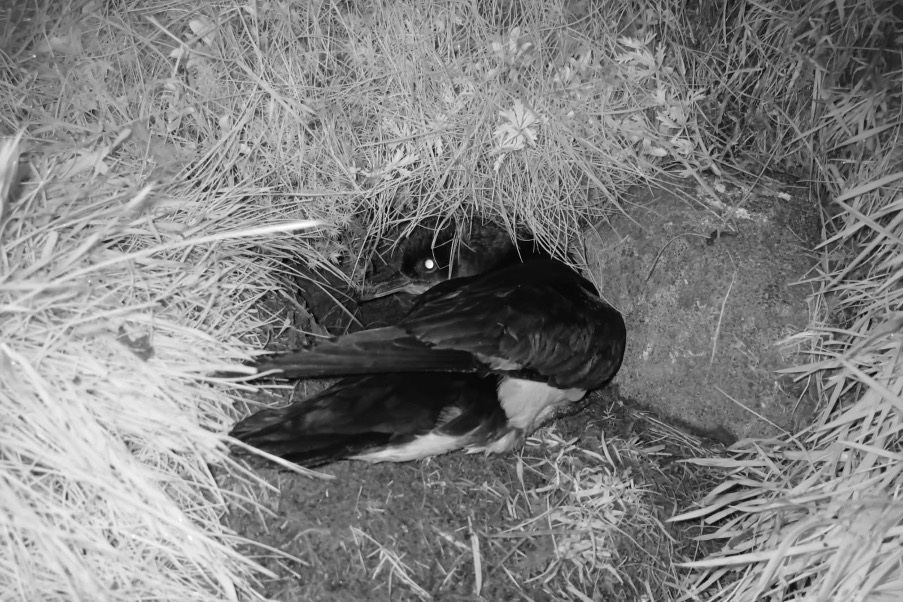
Across birds, laying later is generally not considered the best idea, with later laying birds having a greater chance of breeding failure. It’s thought that birds that breed earlier generally time reproduction better with the annual peaks of food availability in the summer.
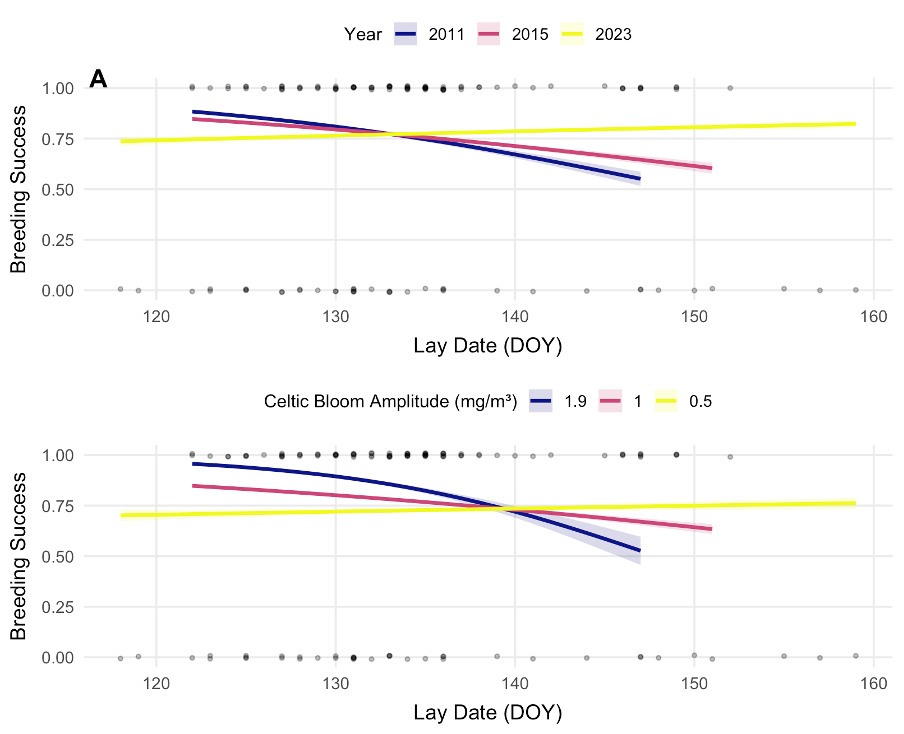
I was interested in exploring the relationship between early laying and breeding success in changing environmental conditions. If laying later is bad for breeding success, then respectfully, why do some birds consistently lay so much later? I found evidence that breeding earlier does not always result in better breeding outcomes for early birds. In fact, in recent years the trend seems to have completely flattened, with the latest birds having no worse breeding outcomes than early birds.
I explored whether this might be linked to changes in the timing of peak food availability, using remotely sensed data to identify the timing and amplitude of the spring blooms of phytoplankton. I found little conclusive evidence of what might be driving this variation, however, I did find that later laying was less costly in years when there were strong phytoplankton blooms in the Celtic Sea, and resources were distributed more evenly across the season. Therefore, there may be less selection on lay date when food is always more readily available across the breeding season and there isn’t a narrow peak in abundance.
In doing this study I have found some cool new things about birds, alongside validation that being early is not always as important as some people say. Understanding what drives the timings of birds is increasingly important in a changing climate. What I have learnt is that timing is a complex interaction of individual and pair behaviour, and that we cannot assume the continuation of long-established biological trends such as that between earlier laying and success under current climate change.
Read the full paper: https://besjournals.onlinelibrary.wiley.com/doi/10.1111/1365-2656.70363

