Competition for limited food resources can be particularly fierce where similarly-related species overlap. Harriet L. Clewlow is a PhD student based at the British Antarctic Survey and linked with University of Exeter and WWF (World Wide Fund for Nature). Her research investigates how climate change is altering interactions between sympatric Antarctic penguin species and predicting their responses to future climate scenarios. Competition is a widely studied … Continue reading Penguin niche-partitioning resilient to climate change
The study of phenology – cyclical patterns of biological events – has long been used to investigate relationships between climate and natural phenomena. In this way, events such as bird migrations, animal breeding periods and plant flowing can be predicted, knowledge which has numerous economic and conservation applications. However, climate change can alter these timings, with dramatic consequences for a range of species. To illustrate … Continue reading Mild winters have butterflies in a flap
New research from Victoria University of Wellington has revealed the population of the common wasp is amplified by spring weather, with warmer and drier springs often meaning more wasps and wasp stings in summer. Continue reading “What will the wasp plague be like this year?”
Showy ornaments used by the male of the species in competition for mates, such as the long tail of a peacock or shaggy mane of a lion, could indicate a species’ risk of decline in a changing climate, according to a new study from Queen Mary University of London (QMUL). Continue reading “Competitive males are a blessing and a curse”
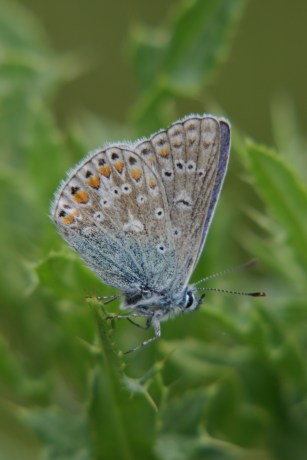
Increasingly frequent extreme weather events could threaten butterfly populations in the UK and could be the cause of recently reported butterfly population crashes, according to research from the University of East Anglia (UEA).
Researchers investigated the impact of Extreme Climatic Events (ECEs) on butterfly populations. The study shows that the impact can be significantly positive and negative, but questions remain as to whether the benefits outweigh the negative effects.
Deer in small wooded patches on the campus of Princeton University. The photos were taken as part of an undergraduate ecology laboratory course taught by my co-author Rob Pringle, and for which I served as an assistant instructor. Students also captured images of foxes, raccoons, and house cats.
In wintertime, it’s often getting dark in Princeton by the time I head home from the office to scrounge up some dinner. Along the half-mile path, I regularly walk or bike within few meters of the local herd of white-tailed deer. There are at least five or six animals that circulate among the tiny patches of trees and streams at the south end of campus. The university deer are just a fraction of the estimated 450-500 that roam the 16 km2 town of Princeton. That’s almost 40 deer per km2, well above the state of New Jersey’s recommended 20-25 per km2. Indeed, much of the northeast U.S. is forced to deal with dense, growing deer populations thanks to the removal of wolves, forest recovery over the last century following the westward shift of American agriculture, and a suburbanization-associated decline in hunting.



 This post is a press release from the authors of Journal of Animal Ecology paper “
 This post is a press release from the authors of Journal of Animal Ecology paper “