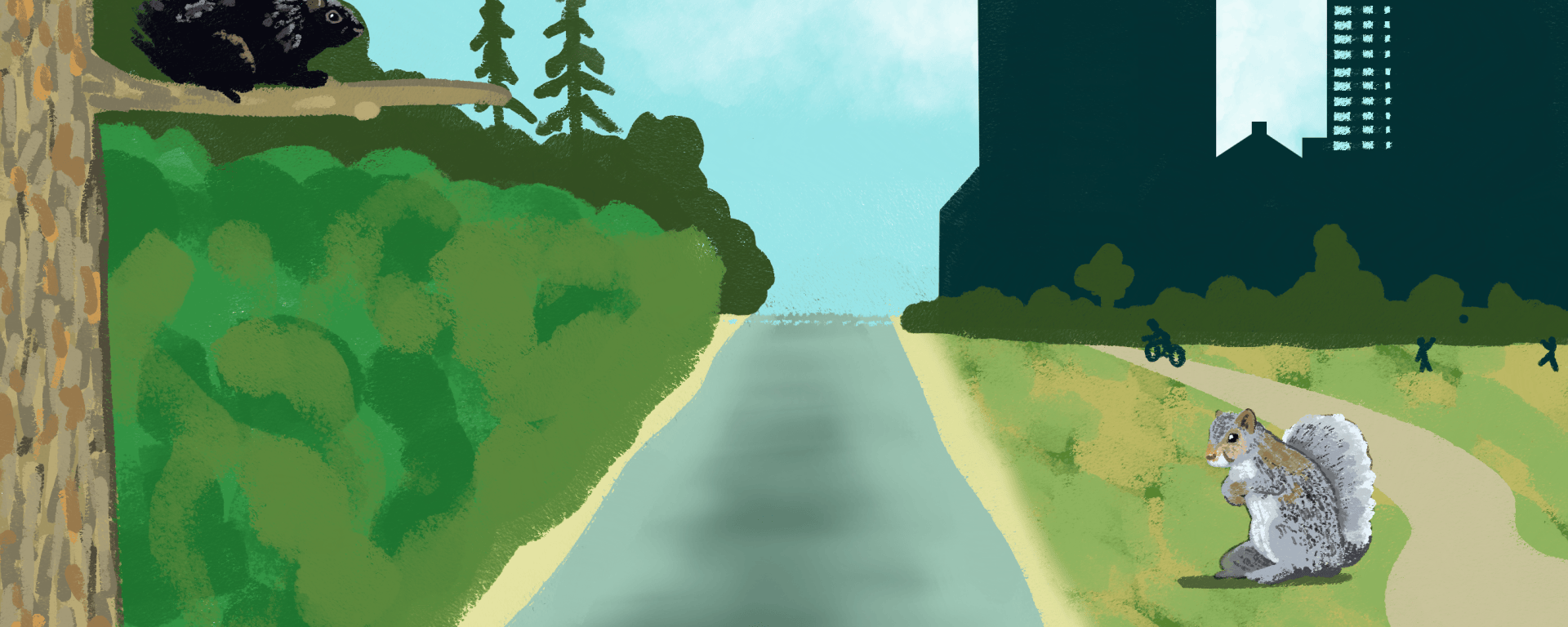
In this blog post, Francis Quang-Hai Dinh tell the #StoryBehindThePaper for the article “Fine-scale spatial variation in eastern grey squirrel melanism across a complex urban landscape“, recently published in the Journal of Animal Ecology. This study utilised surveys of 197 parks and citizen science observations to examine spatial variation in eastern grey squirrel coat colour morphs across Montreal.
spatial variation in eastern grey squirrel coat colour morphs across Montreal.
During my time off from my student job in the summer of 2022, I took to my bicycle, packed a notebook and a water bottle, and made my way to hundreds of parks. I stared up into the trees, given a task: map out the squirrel population all across Montreal and the surrounding suburbs. No further instructions.
Growing up in the inner ring suburbs, I always recognized the unique importance of parks. Hopping on a bike to go meet my friends to play is as routine as it gets for a city boy. Squirrels? They are part of the landscape. I barely even thought of them as wild animals, let alone noticed that they sometimes had black fur. It felt like they magically popped into my field of view once I was told about the urban melanism phenomenon. In eastern gray squirrels (Sciurus carolinensis), there is a general trend of increasing levels of melanism – i.e., a black fur coat – near the city core. This trend is far from uniform, varying from city to city, and we still know rather little about what causes it. The idea of this research was to sample a single city in-depth, focusing on the local scale to see if the macro trends still hold.
The point of biking around the city and staring at squirrels for a whole summer was to explore the factors that actually affect the distribution of melanic squirrels in the city. I appreciate that Montreal is rather uniquely well positioned for this examination, thanks to its highly developed bicycle lane system. 197 parks later, contrary to expectation, I found that Downtown has a lower prevalence of black squirrels than the suburbs. It has to do with the wonderful wooded areas up in the North side of the city where “natural” environments (relatively speaking) allow for the black squirrels to thrive. To compound this effect, the numerous rivers that transect the metro area appeared to prevent or slow down inner-city migration, resulting in fragmented urban-rural slopes across the city.
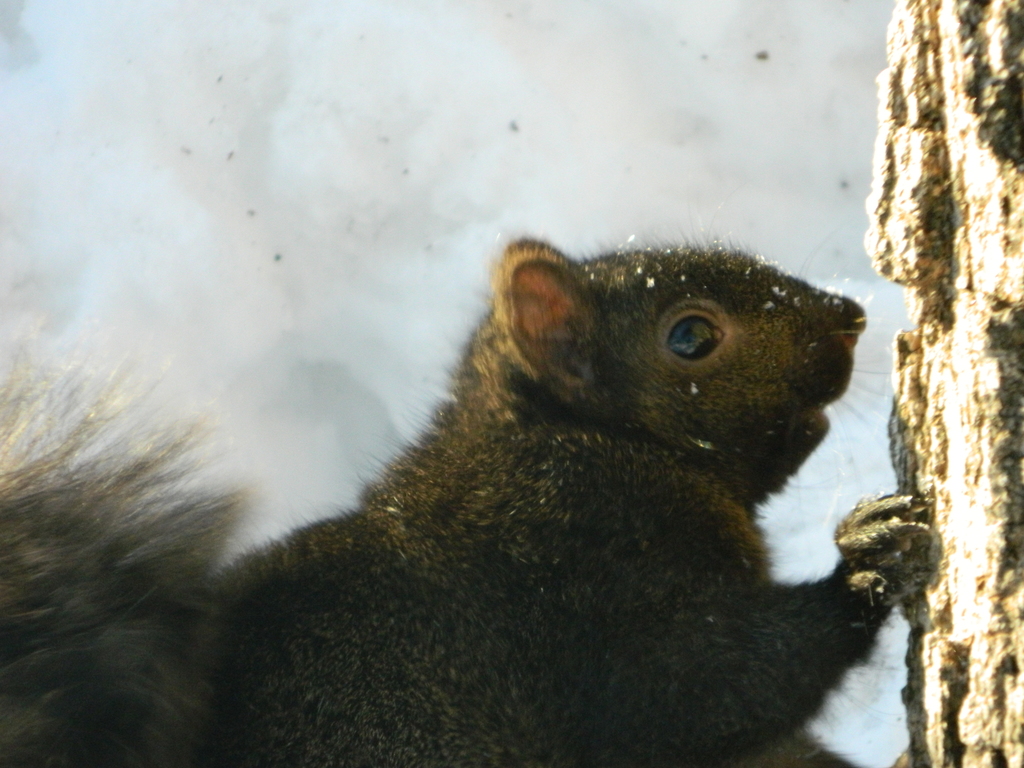
The findings tell a story about nature defying easy assumptions. Cities aren’t uniform slabs of concrete, and wildlife doesn’t follow our tidy urban-rural diagrams. Montreal’s squirrels adapt to human density, but also to waterways and microenvironments that were here long before our buildings. Yet the way we arrived at this conclusion matters just as much as the result itself.
In addition to my field observations, I used citizen science logs. Databases such as iNaturalist are an incredible repository of observations from people who, just like me, seek to document the wildlife that lives around them. In fact, my study has its genesis with our senior author got involved with SquirrelMapper, a collaborative and volunteer-based project hosted on iNaturalist and on Zooniverse. Since citizen science improves in quality with the total number of participants, this data was the perfect supplement for this urban ecology project. My analysis also wouldn’t have been possible without the help of a grad student who knew how to make use of municipal, provincial and federal geospatial datasets. Once environmental data on the city parks that I visited was extracted, it became easy to correlate various factors with squirrel data. It was a matter of finding someone dedicated enough to compile, analyze and write up the findings using this wealth of publicly available data.
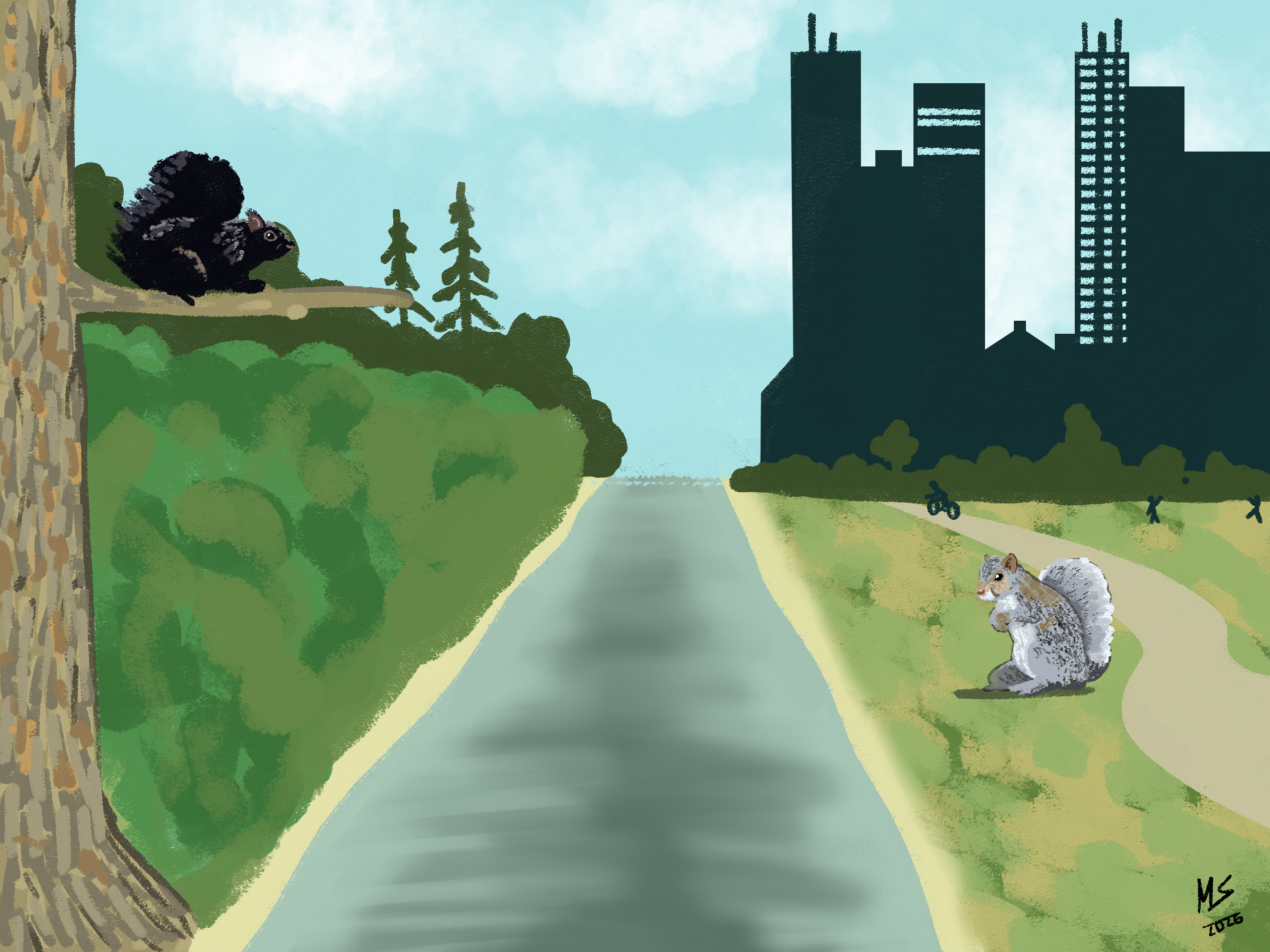
Historically, large-scale ecology often required massive institutional budgets and proprietary infrastructure. Here, the setup was fundamentally different: open geospatial datasets, public transit and bike networks, hundreds of community contributions on iNaturalist, and an undergraduate willing to spend a summer pedalling between boroughs.
This is what a “big tent” approach in macrosystems biology looks like in practice. By pairing public data with community science, research becomes more collaborative, transparent, and grounded in the communities where the data originates. Capturing broad evolutionary patterns can come from specialized field stations as much as it can come from open tools and thousands of eyes across the city.
Nature doesn’t stop where the sidewalk begins, and science shouldn’t either. When we treat open data as shared public infrastructure, the urban landscape turns into a big science park: accessible to anyone curious enough to grab a bike, look up, and notice the wild world coexisting right above their heads.
About the blog author: I am a PhD student in the Department of Evolution, Ecology and Behavior at the University of Illinois Urbana-Champaign. This work was completed while I was an undergrad at McGill University, in Montreal where I grew up. I know the streets like the back of my hand and I know the best parks in town.
Read the paper here:
https://besjournals.onlinelibrary.wiley.com/doi/10.1111/1365-2656.70295

