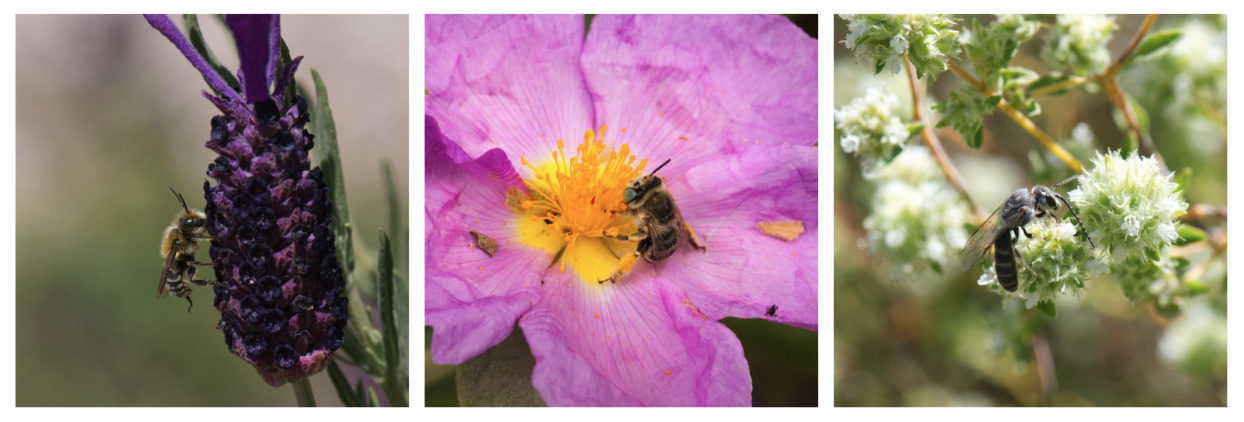
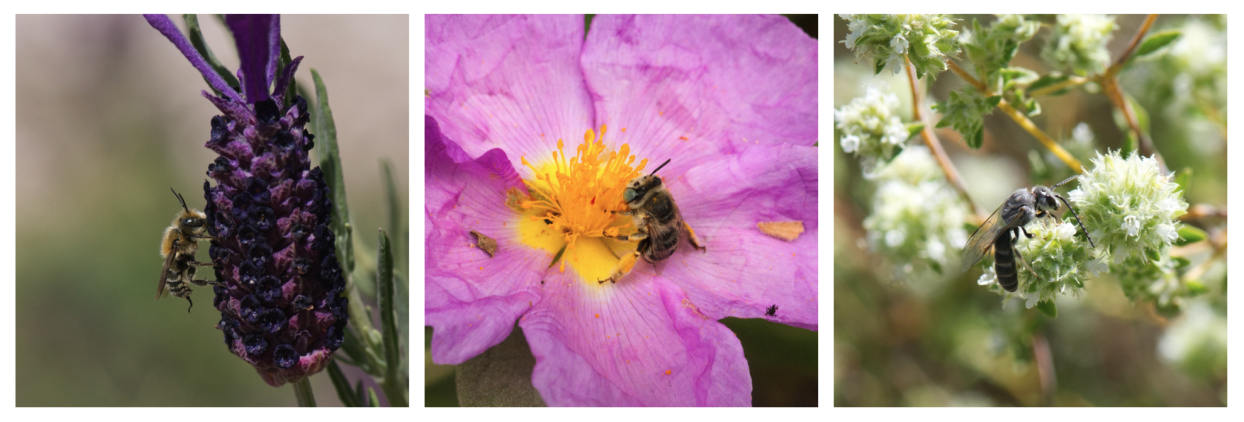
In this blog post, Blanca Arroyo-Correa tells the #StoryBehindThePaper for the article “Mutual networks emerge from the interplay of abundance, behaviour and spatial constraints“, recently published in the Journal of Animal Ecology. The study utilised agent-based models to understand if individual interactions can be used to understand complex plant-pollinator networks .
From forests and coral reefs to the microbes living inside our bodies, nature is organized as complex networks of interacting organisms. These organisms are connected through countless interactions including predation, competition, parasitism, or mutualism, that together determine how ecosystems function and respond to environmental change.
Understanding how these networks are assembled is one of the central challenges in ecology. Why do some species interact with many partners while others have only a few? Why do certain network structures repeatedly emerge across ecosystems? Can we predict how these networks will shift as biodiversity changes? For decades, ecologists have searched for answers by examining the characteristics of species themselves, such as how abundant they are, what they prefer, and whether they “fit” their potential partners. But what if we look at the problem on a different scale?
Networks are built one interaction at a time
Ecological networks are not simply the result of relationships among species. They emerge from thousands or millions of individual encounters. An individual predator decides whether to chase an individual prey. An individual seed disperser chooses one individual fruit over another. An individual pollinator visits one individual flower and ignores the next. Each decision may seem insignificant. Yet together, these countless interactions shape the architecture of entire ecological communities. This raises a fascinating question: Can we understand complex ecological networks by studying the simple rules followed by individual organisms?
Plant–pollinator communities provide an ideal system to explore this question. They are among the best-studied ecological networks, are essential for maintaining biodiversity and ecosystem functioning, and every interaction can be directly observed in the field. Every flower visit results from a pollinator moving through space, encountering plants, and deciding where to forage. Scale up those individual choices across an entire community, and an ecological network emerges.
Simulating thousands of individual encounters
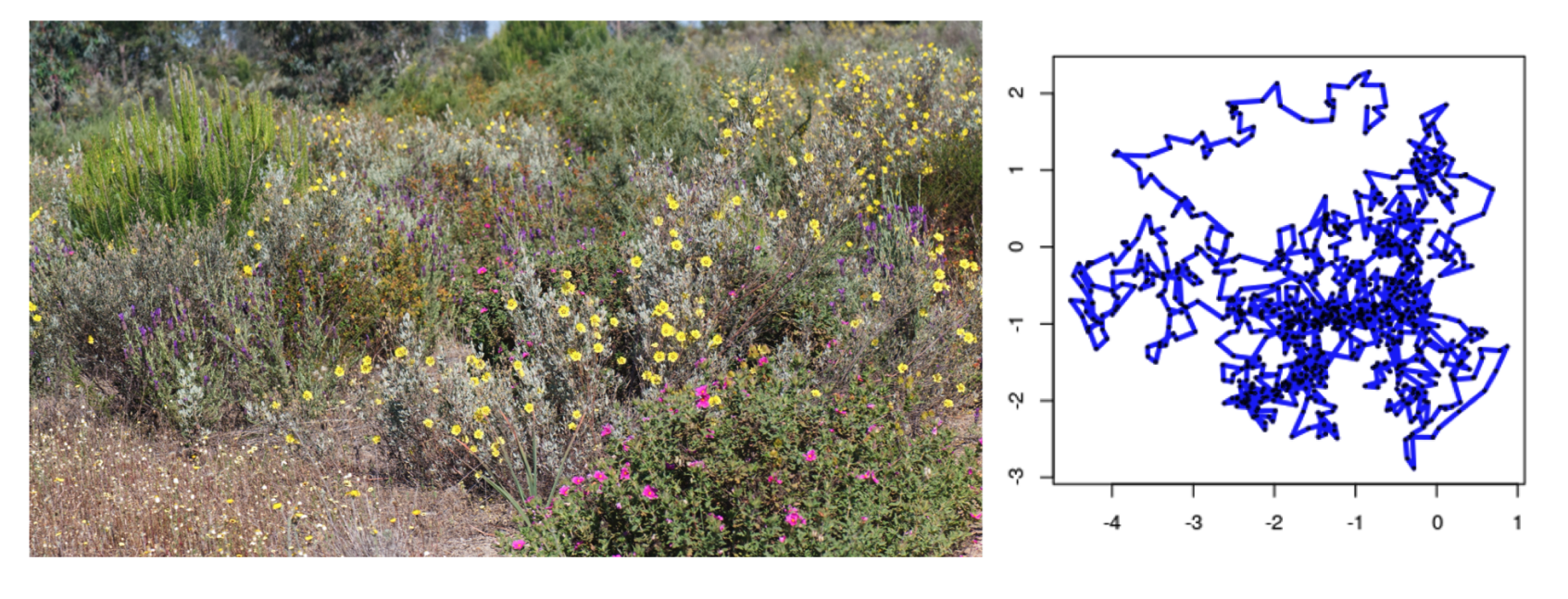
In our study, we started with field observations from Mediterranean shrublands in Doñana National Park, Spain. We then asked a simple question: Which ecological processes are necessary to reproduce the ecological networks we observe in nature?
To tackle this question, we used a powerful computational approach, called agent-based models. First, we built a virtual space where interactions take place. Every plant and pollinator exists as an individual following simple rules of interaction. Instead of telling the model which species should interact, we let ecological networks emerge naturally from thousands of simulated encounters, where individual plants are fixed in space, and individual pollinators follow simple behavioural rules and move across the landscape. These simulations create interactions one visit at a time. But simulations are only as useful as the assumptions behind them. To bridge the gap between theory and reality, we allowed the simulations to learn directly from field observations. By repeatedly comparing simulated networks with the ones we observed in nature, our framework identified the combinations of mechanisms that most plausibly generated the real communities.
Together, this approach allowed us to move beyond asking whether a mechanism matters, to asking how much it contributes to shaping ecological networks. In fact, we asked which is the minimal set of mechanisms that are needed to recover real networks. To answer it, we progressively increased the realism of our simulations. First, we considered only species abundances. Next, we allowed pollinator species to differ in their foraging behaviour. Finally, we incorporated the actual spatial arrangement of every plant mapped in the field.
Complexity emerges from surprisingly simple rules
Species abundance certainly mattered. Individuals belonging to common species naturally have more opportunities to interact. But abundance alone wasn’t enough. Our simulations improved significantly at reproducing real ecological networks once we accounted for two additional factors: pollinator behavior and plant location.
Pollinator species differ in how they explore the landscape. Some forage intensively and move rapidly between plants, while others are more occasional visitors. At the same time, plants are far from randomly distributed. They form patches, creating local neighbourhoods that strongly influence which interactions can occur. Together, these relatively simple mechanisms explained much of the observed network structure. Perhaps most surprisingly, they did so without explicitly including detailed trait matching between species. In our study system, the combination of abundance, behaviour and spatial organization captured much of the complexity traditionally attributed solely to species traits or abundances.
Seeing ecological networks from the bottom up
One of the broader messages of our work is that ecological networks should not only be viewed as collections of interacting species. They are also the outcome of processes occurring at much smaller scales. Community-level patterns emerge because individuals move, explore, make decisions, and encounter one another within heterogeneous landscapes. Our “bottom-up” perspective provides a framework for understanding how local changes—such as habitat fragmentation, altered movement behaviour or shifts in species abundances—can ripple through ecosystems to reshape entire communities.
This study shows that understanding ecological networks doesn’t always require adding more complexity. Sometimes, it requires looking more closely at the processes that happen on the ground. As new technologies allow us to track individual organisms with increasing precision, ecology is entering an exciting era in which we can directly link processes and patterns across scales and organization levels, from individuals to communities and beyond. After all, every ecological network—no matter how large or complex—begins with a single interaction between two individuals.
Read the paper here: https://besjournals.onlinelibrary.wiley.com/doi/full/10.1111/1365-2656.70324?casa_token=YVdTBN46iAAAAAAA%3AZ2G0gqo8GqXZv3qsduLTy4TCdCUNBfgTndszD6xAvlAVpmxd–9rwMjzV97flql2b0jcXVpcm4VNg5GHQg

