This blog post is provided by Jean-Dominique Lebreton and Madan K. Oli and tells the #StoryBehindThePaper for the article “Reproductive value as a key concept in ecology and evolutionary biology”, which was recently published in Journal of Animal Ecology. In their study, Lebreton, Oli and colleagues break down the meaning of reproductive value, an idea first proposed by R. A. Fisher almost a century ago to understand what the future holds for a population.
So, what on earth is reproductive value?
Mama Bird and Junior have a problem.
Someone has put an equation in front of them. A rather intimidating one. It comes from R. A. Fisher, one of the founders of modern evolutionary biology, and describes something called reproductive value.
Judging by their expressions, this has not improved their day.
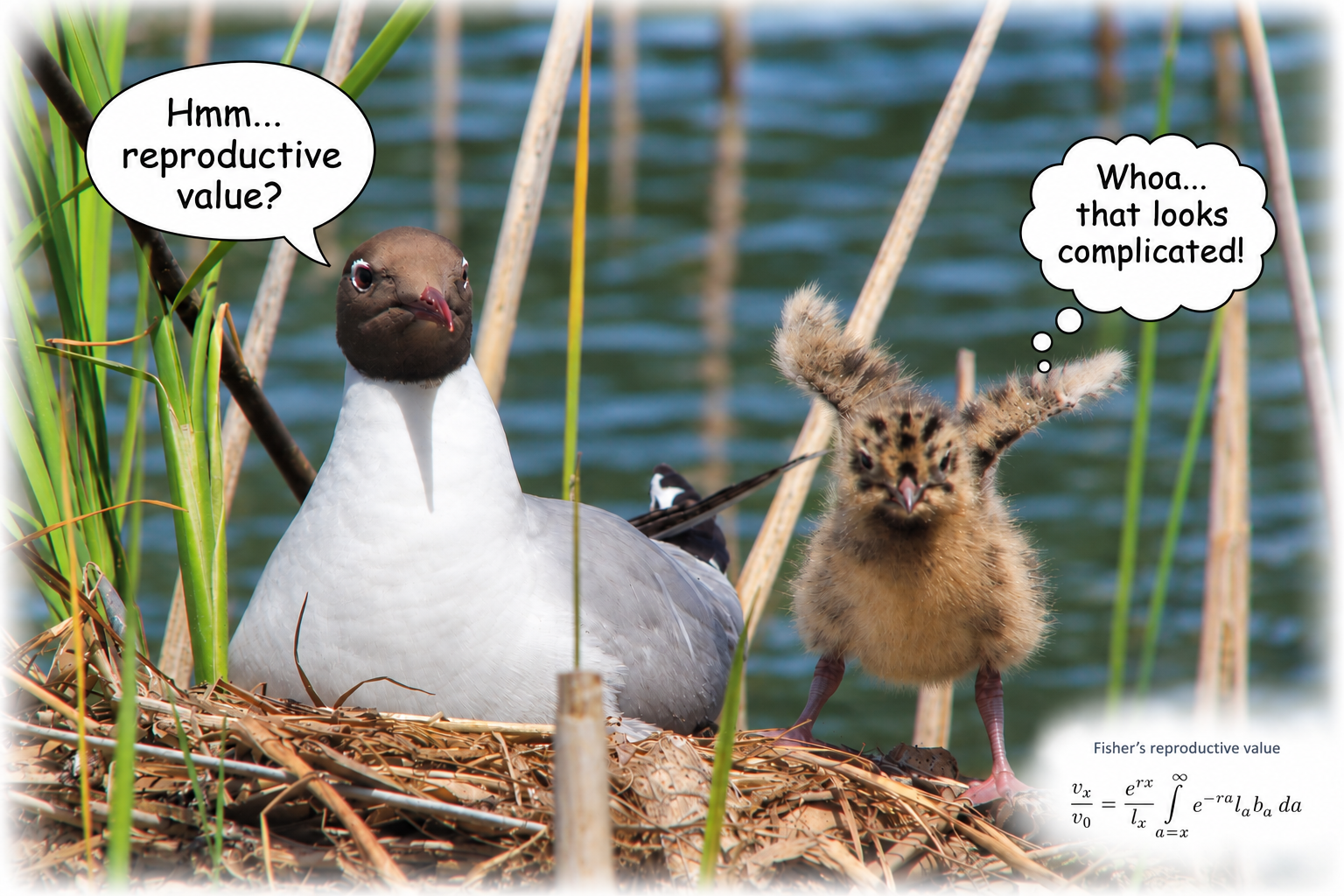
Fortunately, the idea behind the equation is much easier than the mathematics makes it look.
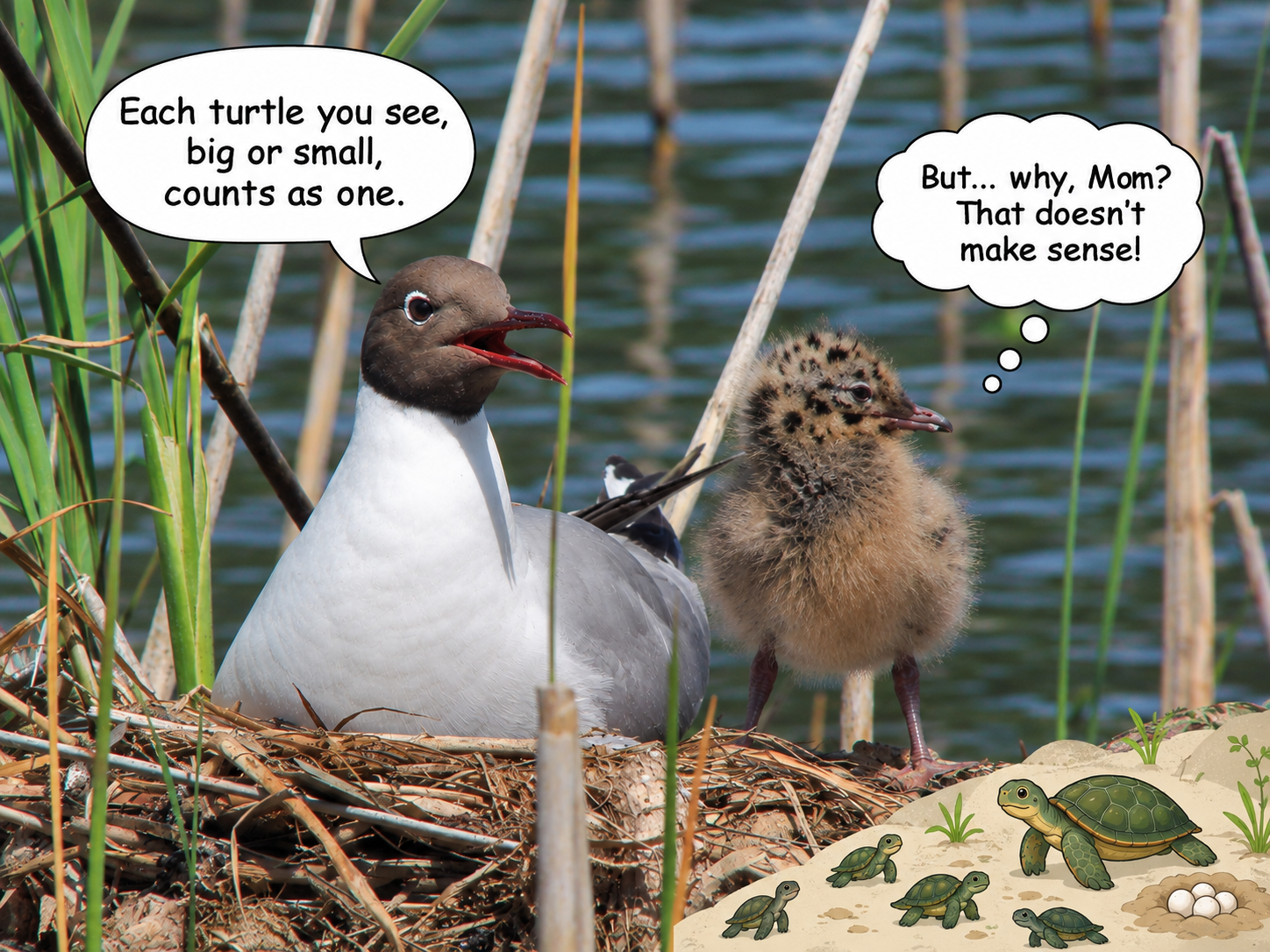
Imagine a population of 100 animals. When we count them, each animal counts as one. But does each contribute equally to the future of the population?
Usually not.
A newborn, an experienced breeder and an old animal near the end of its life may all add one to today’s head count. But their chances of surviving and reproducing in the future can be very different.
Reproductive value gives us a way to quantify those differences.
Fisher introduced the idea almost a century ago, mainly to describe differences among ages. But why stop there? Animals can differ by sex, size, breeding status, social position, infection status or where they live. Any of these differences can affect what happens to the population next.
Over the years, reproductive value has turned up in seemingly different corners of biology: population growth, evolution, conservation, harvesting, animal movement and even infectious disease.
That was one reason we wrote this paper. We kept finding the same basic idea turning up in places that, on the surface, seemed to have little to do with one another.
Look a little closer, though, and the same question keeps appearing:
Who or what matters most to the future? A lot of little turtles or a few big ones?
Sea turtles provide a wonderful example. Suppose you want to help a threatened turtle population. Protecting nests seems an obvious place to start. Save the eggs. Help the hatchlings reach the sea. More baby turtles must mean more turtles in the future.
Right?
Well… not necessarily.
Eggs and hatchlings face a long and dangerous journey before they can reproduce. A large juvenile has already survived many of those hazards and is much closer to becoming a breeder. That gives the older turtle a much greater reproductive value.
And here is the important bit: it takes an awful lot of little turtles to make a few big ones. Roughly one hatchling in a thousand may survive to adulthood, although the number varies among species and populations. By the time a turtle becomes a large juvenile, it has already survived much of that demographic gauntlet.
Here came the demographic surprise. Classic studies of loggerhead sea turtles showed that population growth was much more responsive to the survival of large juveniles and subadults than to similar changes early in life. This helped focus attention on reducing the accidental deaths of larger turtles in fishing gear.
The lesson was not that eggs don’t matter. Of course they do.
It was more interesting than that:
A lot of little turtles are not automatically more important than a few big ones.
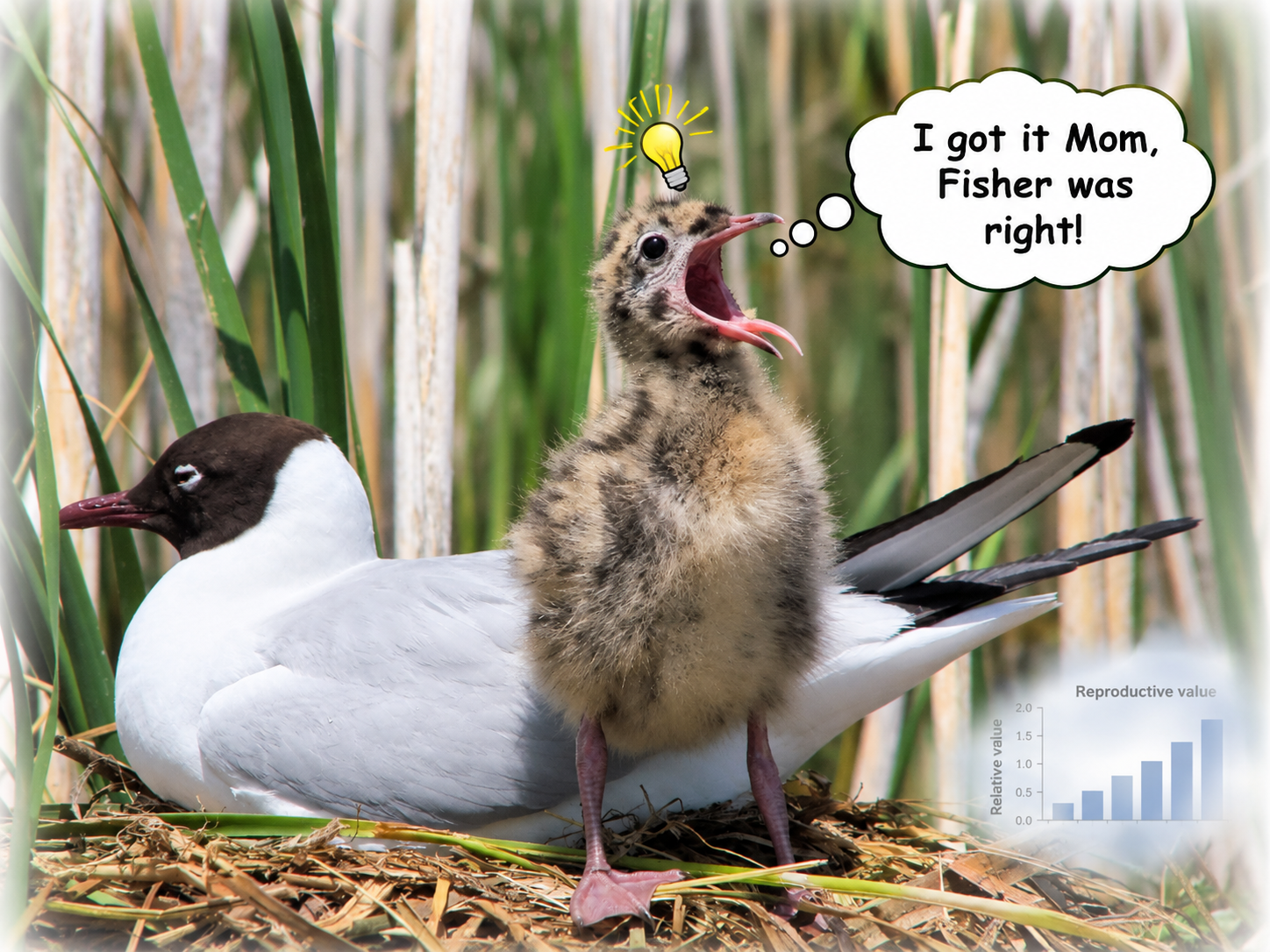
Mama Bird is beginning to see the point.
And judging by the light bulb above Junior’s head, Fisher’s equation may finally be making some sense.
How much future just moved?
Then reproductive value does something even stranger.
It starts travelling.
Imagine a population spread across several places. One habitat produces lots of animals that eventually move elsewhere. Another contains plenty of animals, but only because newcomers keep arriving.
A head count might make both places look important. But their contributions to the population’s future could be very different.
Movement between them adds another wrinkle. Ten young animals leaving one place are not necessarily demographically equivalent to ten experienced breeders arriving from another.
Sometimes the interesting question isn’t simply:
How many animals moved?
It is:
How much future moved with them?
That sounds almost philosophical. It is actually population ecology.
And it can be quite practical. A place does not have to contain lots of animals to make an important contribution to the future of the population. Some places produce animals that populate other places; others persist largely because those animals arrive.
A census tells us where the animals are.
Reproductive value can help tell us where the future is coming from.
Junior is now looking considerably less worried about Fisher’s equation.
And then disease crashes the party
Just when things seem complicated enough, add a pathogen.
Now an animal can contribute to two futures: the future of the host population and the future of the pathogen.
Those need not be the same.
An animal may be very important to future population growth but relatively unimportant for spreading infection. Another may contribute little to population growth while playing an outsized role in transmission. Age, social status, behaviour and infection state can all change the answer.
Suddenly we have two questions:
Who matters most to the future of the population?
And:
Who matters most to the future of the disease?
Fisher’s old idea has travelled quite a long way from that equation.
Will reproductive value solve everything?
Probably not.
Populations are complicated. Weather changes. Habitats change. Diseases arrive. Individuals interact. And animals occasionally refuse to behave the way our models say they should.
But reproductive value gives us a useful way to think about all of this.
Ecologists spend a lot of time counting animals—and for good reason. But a head count is a snapshot. It tells us how many animals are there now. It does not necessarily tell us how much each contributes to what happens next.
Two populations with exactly the same number of animals can therefore have very different prospects. Losing ten animals from one stage of life may have very different consequences from losing ten from another. And a small habitat may matter far more than its size suggests if it contributes disproportionately to the rest of the population.
Nearly a century after Fisher introduced reproductive value, the mathematics surrounding it has become considerably richer. But the question underneath it remains wonderfully simple:
Where is the future of this population hiding?
Sometimes it is in an experienced breeder.
Sometimes it is in a particular habitat.
Sometimes it is moving between populations.
And sometimes—even more inconveniently—it is carrying a pathogen.
Which brings us back to Mama Bird and Junior.
So, will reproductive value solve all of Mama Bird’s and Junior’s problems?
Probably not.
But it gives them an excellent place to start.
And judging by that equation, they could use one.
Read the paper
Read the full paper here: https://doi.org/10.1111/1365-2656.70343

